
Inside the Stack of Context Engineering
A practical guide to AI context systems

Everybody learned prompt engineering.
Many courses were sold.
Many job titles were created.
LinkedIn became full of people calling themselves Prompt Engineers.
Then something quietly changed.
The models got better.
The tasks got harder.
And suddenly writing a clever prompt stopped being the bottleneck. Something else was breaking. And most people building AI products could not figure out what.
The thing that was breaking was context. And the discipline that grew up to fix it has a name now.
Context engineering. The skill that actually matters in 2026.
What went wrong with prompt engineering
Prompt engineering worked when AI was simple.
You typed a question.
The model answered.
If the answer was bad you rephrased the question.
You iterated until something decent came out.
That was the whole job.
Then people started building agents. Systems that used tools, remembered conversations, pulled in documents, made decisions across multiple steps. And prompt engineering fell apart completely.
Because the problem was never the wording. The problem was what the model could see.
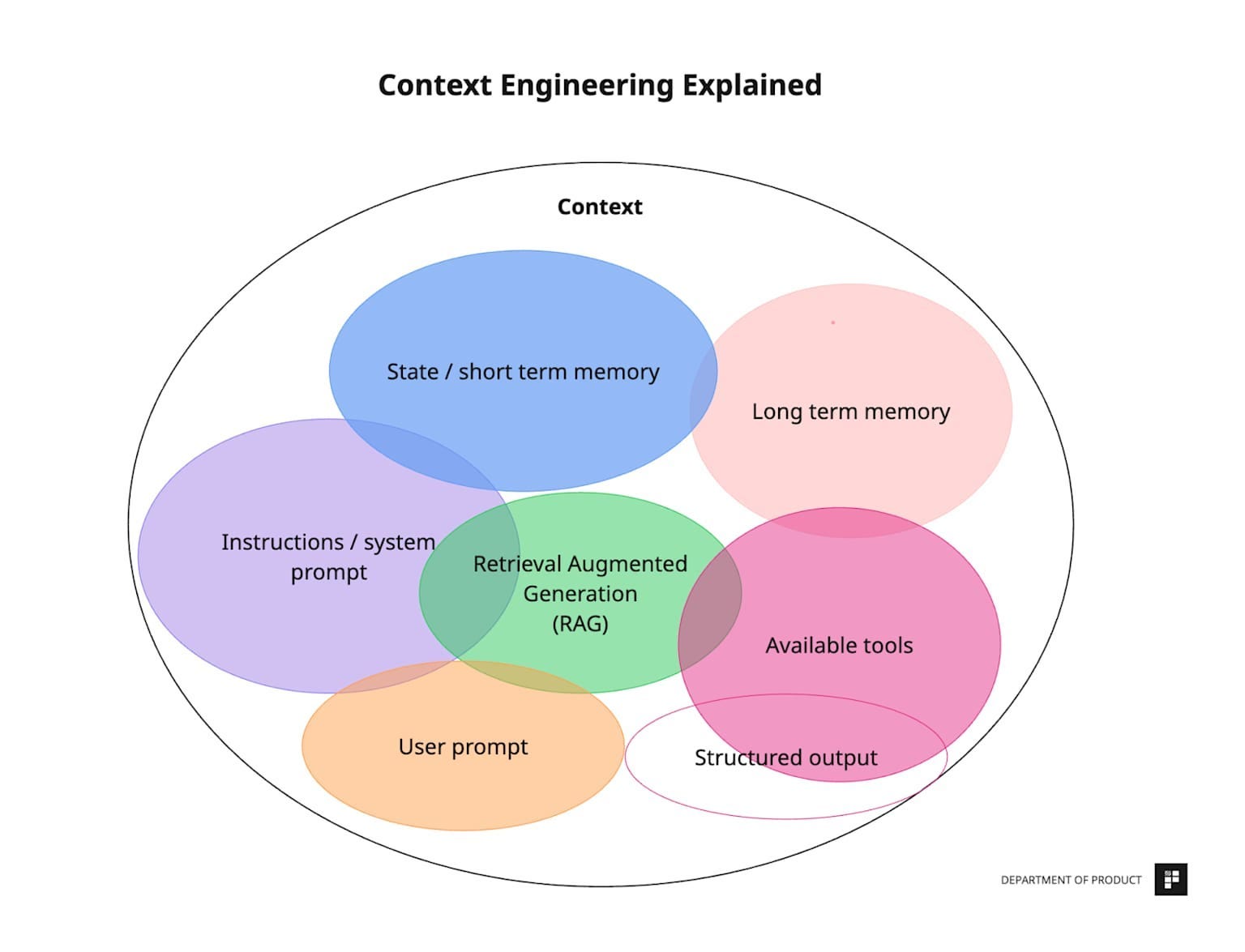
An AI model at any given moment only knows what is inside its context window.
That one snapshot of information is everything.
Its instructions.
The conversation history.
The documents you fed it.
The tools it can use.
Its memory of what happened three steps ago.
If any part of that snapshot is wrong, missing, outdated or just too much the model fails.
Not because it is stupid. Because it was given bad information to work with.
That is a context problem not a prompt problem. And rephrasing your question does not fix it.
The actual definition you need to understand
Prompt engineering asks what words should I use.
Context engineering asks what should the model be able to see right now to do this job well.
That is the whole distinction and it matters more than it sounds.
When your AI agent gives you a weird answer or forgets something from earlier or confidently says something wrong the model itself is usually fine. The underlying intelligence is working. What failed is the information pipeline feeding into it.
Most agent failures are context failures. Bad state management. Wrong documents retrieved. Conversation history that got too long and started losing the beginning. Tool definitions that confused the model about what it could actually do.
Context engineering is the discipline of fixing all of that deliberately. Not by accident. Not by vibe. By design.
The four things living inside every context window
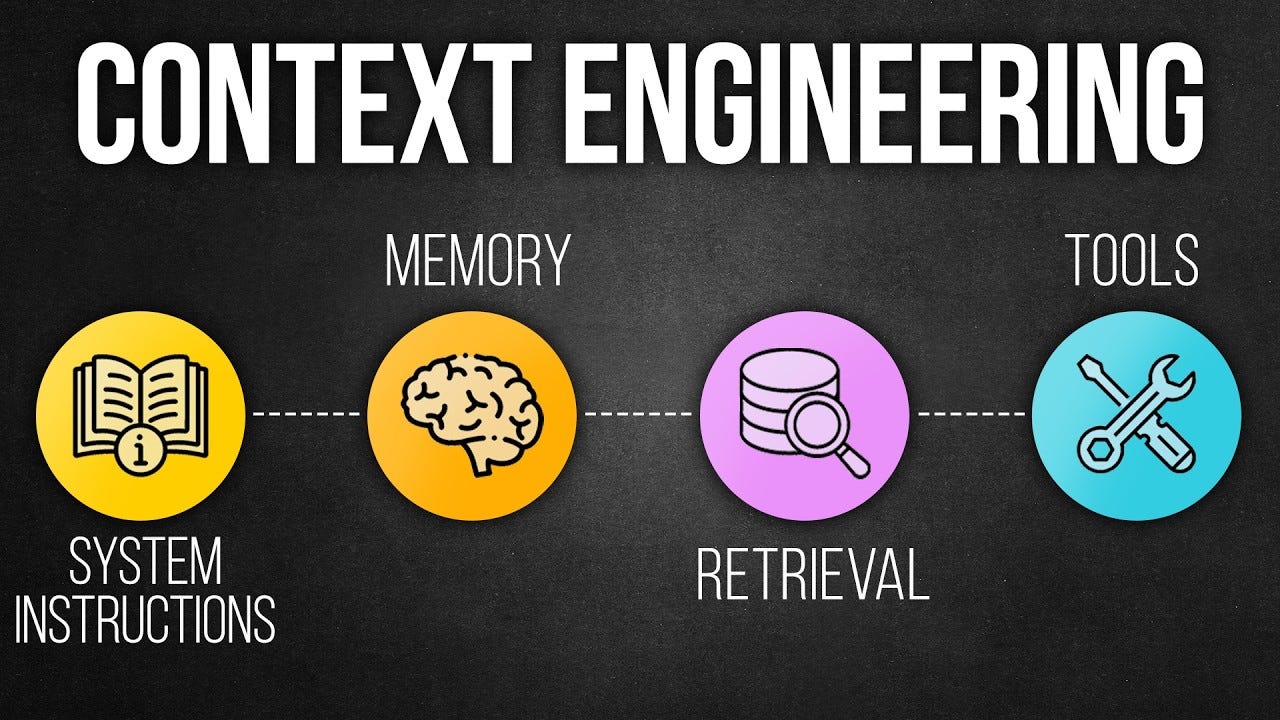
To understand context engineering you need to know what actually goes into a context window when an agent runs.
There are four things and each one can be done well or badly.
1st is INSTRUCTIONS. The system prompt. What the agent is supposed to be and do and avoid. Most people write this once and never touch it again. Good context engineers treat it as a living document that gets tested and refined based on how the agent actually behaves in the real world.
2nd is MEMORY. What the agent knows from past interactions. Short term memory is the current conversation. Long term memory is everything it has been told or learned across many sessions. Without a proper memory system the agent starts every session knowing nothing about your specific context your preferences or the mistakes it made last time.
3rd is RETRIEVAL INFORMATION. When the agent needs a fact or a document it has to go find it. How it searches, what it retrieves and how much of it gets put into context makes an enormous difference to the quality of what comes out. Put in the wrong documents and the model confidently uses wrong information. Put in too many documents and important things get buried and forgotten.
4th is tool DEFINATIONS. If the agent can take actions like search the web or write to a database or send an email the model needs to understand exactly what those tools do and when to use them. Vague tool descriptions are one of the most common reasons agents do unexpected things.
These (04) things together are your context stack.
Context engineering is the practice of designing and managing all four of them with the same care a software engineer gives to actual code.
The problems that kill agents quietly
There are three failure modes that show up constantly in production agent systems and all three are context problems.
The first is context poisoning. This is when wrong or outdated information gets into the context and the model treats it as true.
It has no way to know the document is old. It has no way to know that fact was wrong when it was retrieved. It just uses what it was given. The output looks confident and is completely wrong.
The fix is treating everything that enters context as something that needs to be verified and timestamped.
The second is context overload. Modern models have large context windows. A million tokens sounds like infinite space. But filling that window with everything you have is a terrible strategy.
More information does not mean better answers. It means the model has to figure out what matters and that is genuinely hard for it. The most important information gets diluted. Critical instructions near the beginning get forgotten by the time the model reaches the end.
The engineers building the best agents are obsessive about context budgets. They ask where should these 32,000 tokens actually go this turn. Not how much can I fit in. How much is actually needed.
The third is state drift. In long multi-step agent tasks the context changes as the agent works. New information comes in. Old information becomes irrelevant. If nobody is managing that state carefully the agent starts working with a picture of the world that no longer matches reality.
Fixing state drift means building systems that actively update and clean the context as a task progresses rather than just adding to it endlessly.
Why this replaced Prompt Engineering as the main skill
There is a simple way to see why this shift happened.
In 2023 you could build something impressive with a well written prompt. The bar was low. The tasks were simple. Getting good output was mainly about phrasing.
In 2026 you are building agents that run for hours.
That make decisions across dozens of steps. That use multiple tools. That need to remember things from last week. That interact with real systems and produce real consequences.
At that scale the prompt is maybe five percent of the problem. The other 95 percent is everything that goes into and around the prompt.
Job listings reflect this. Roles titled prompt engineer have largely disappeared from 2026 hiring.
The companies building serious AI products are now hiring for AI engineers, agent engineers and increasingly people who specifically list context engineering experience.
The interview questions have changed too. Instead of write me a good prompt for this task the question is now you have 32,000 tokens per turn to spend on this agent. Walk me through how you would allocate them and why.
That is a fundamentally different and more serious discipline.
What good context engineering actually looks like in practice
Here is where it gets concrete.
Good context engineering starts before you write a single prompt. It starts with mapping the information the agent actually needs to do its job.
What does it need to know at every step. Where does that information come from. How fresh does it need to be. How much of it is needed at once versus on demand.
From that map you design a retrieval system that fetches the right pieces at the right moments rather than loading everything upfront. You design a memory structure that persists the right things across sessions and forgets the things that are no longer useful.
You write tool definitions that are specific and unambiguous rather than vague descriptions that leave the model guessing.
You build an evaluation system before you start optimizing. Because context engineering done by gut feel is how you ship regressions silently.
You need to be able to measure whether a change to your retrieval strategy or memory structure actually made the agent better or just felt like it did.
And you treat your system prompt as code. Versioned. Tested. Reviewed. Not as a text file someone wrote once and everyone is scared to touch.
The honest reason most AI products underperform
Most AI products are not limited by the model they chose.
Claude Fable 5 and GPT-5 are extraordinary pieces of technology. Kimi K3 and DeepSeek V4 are extraordinary and free.
The raw capability sitting inside these models is almost certainly beyond what most applications are actually using.
What limits the product is the context engineering around the model.
How information is structured and delivered.
What the model can see at each step.
How memory is managed. How retrieval is designed.
How state is maintained across a long task.
Fix the context engineering and the same model that was producing mediocre output starts producing remarkable output. Not because the model changed. Because what you fed it changed.
This is the insight that separates the teams building AI products that actually work in production from the teams endlessly chasing better models hoping that will solve the problem.
The model is rarely the problem. The context is.
What to do if you are building anything with AI right now
You do not need to master all of this immediately. But there are three things worth doing right now if you are building anything serious with AI.
Start tracking where your context tokens are actually going. Most people have no idea. Open the raw input your model receives on a typical request and look at it.
What is in there.
How much of it is actually necessary.
You will almost certainly find things that can be removed or compressed without hurting performance.
Give your agent a real memory structure. A state file that gets written at the end of every session and read at the start of the next one. This one change alone will make any agent feel dramatically more capable because it stops starting from zero every time.
Write your tool definitions like documentation for a new colleague not like a technical spec for a computer. The model understands natural language better than formal notation. Be specific about what the tool does, when to use it and crucially when not to use it.
Those three things will close more of the gap between where your agent is and where you want it to be than any amount of model switching.
Summary
Prompt engineering was the skill of 2023.
Context engineering is the skill of right now.
The difference is not just technical. It is a completely different way of thinking about why AI fails and what to do about it.
Stop asking how should I phrase this. Start asking what does the model need to see right now to do this job well.
That question leads somewhere much more useful. And the engineers who have internalized it are building things that the prompt engineers who have not made the shift simply cannot match.
The context window is everything the model knows in that moment. Engineering it carefully is the whole job now.
Stay blessed
Regards: Engine AI